![]() |
Venezuela | ![]() |
| Bolivarian Republic of Venezuela | ||
| November 27-28 |
| Americas |
| |||||||||||||||||||||||||||||||||||||||||||||||||||||||||||||||||||||
| Population | Ann.Gr. | Density | |
| 2000 | 24,169,722 | +2.04% | 27 per sq. km. |
| 2010 | 28,715,855 | +1.64% | 31 per sq. km. |
| 2025 | 34,775,110 | +1.11% | 38 per sq. km. |
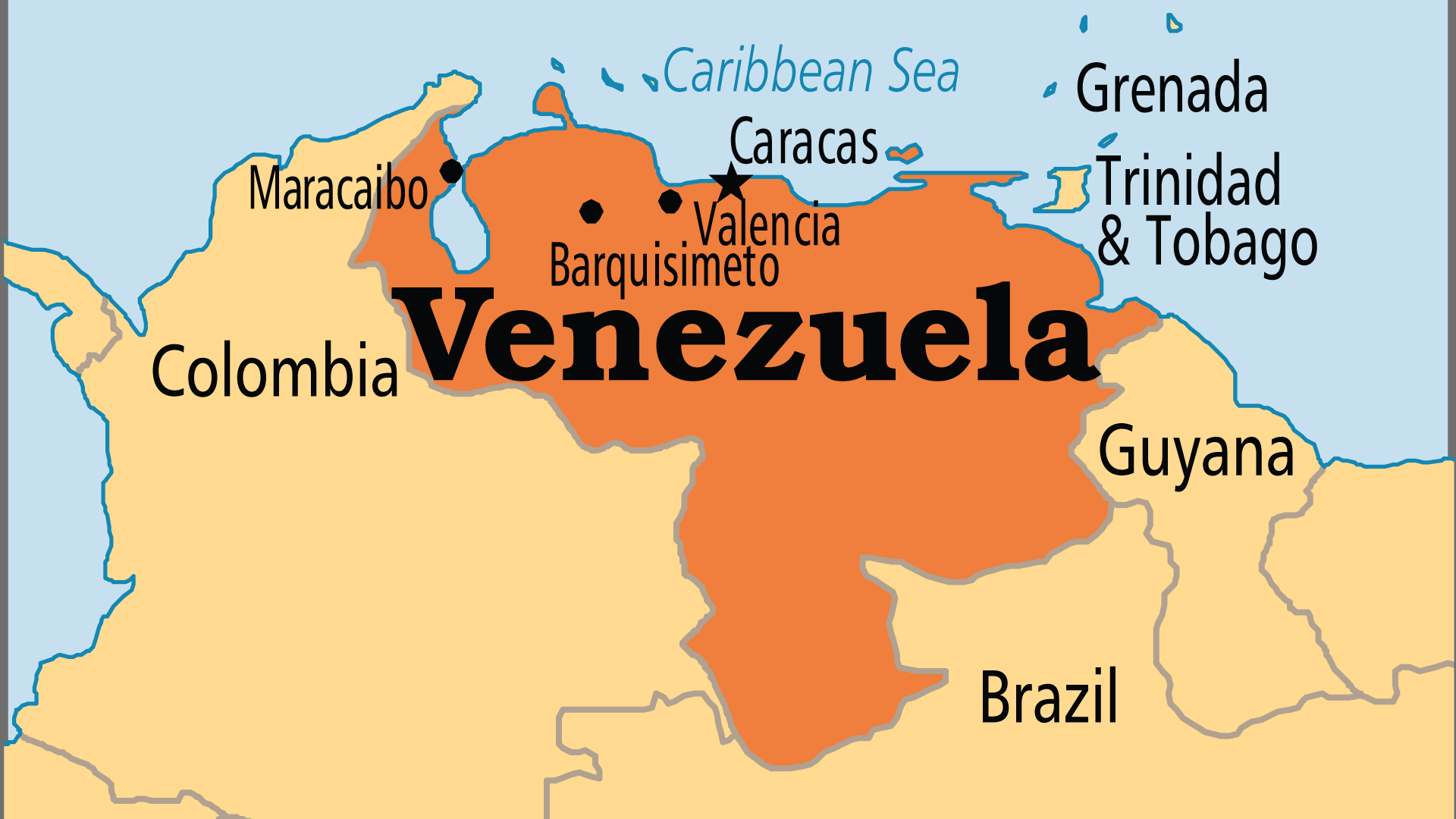
Capital Caracas 4,200,000. Other major cities:
Maracaibo 1.8 mill.; Valencia 1.48m; Maracay 1,075,000. Urbanites 87%.
Venezuelans 87.2%. Mixed Spanish, indigenous and African background. No census has been taken which classified the population according to ethnicity. Roughly 61% Mestizo, 16% European, 10% African.
Foreigners 11.3%. From 80 different ethnicities.
Amerindians 1.5%. 27 peoples including Yanomami, Guajiro, Maquiritare, Panare and Motilone.
Literacy 90.9%. Official language Spanish. All indigenous languages 40. Languages with Scriptures 1Bi 13NT 7por 14w.i.p.
One of the world's largest oil producers. About 33% of the GDP and 80% of export earnings come from oil. Falling oil prices in the 1980s, unwise government spending, a bloated civil sector and widespread corruption by the rich elite combined to impoverish ¾ of the population. A declining tourist sector and natural disasters ($20 billion damage in 1999) conspire against economic diversification and stability. Unemployment 27%. HDI 0.792; 48th/174. Public debt 33.6% of GNP. Income/person $3,480 (11% of USA).
Independent from Spain as part of Gran Colombia in 1821; and as a separate state in 1830. A succession of revolutions and harsh dictatorships ended in 1958. Stable democracy for decades until economic stress and disillusionment with corrupt government provoked a number of civilian riots and political coup attempts led by an army colonel who was elected president in 1998 on a platform of anti-corruption and economic reform. Since then government (including the constitution) has been trimmed, empowering the authoritarian-style President. Many hope that political stability and a streamlined government will lead to positive socio-economic changes. A new constitution and restructured national assembly was approved in a referendum in 2000.
Religious freedom is still guaranteed in the constitution. The Catholic Church regained official recognition in 1964 after years of strained Church-State relations, and has a strong influence which sometimes causes difficulties for foreign missions especially in reaching the indigenous Amerindians.
| Religions | Population % | Adherents | Ann.Gr. |
| Christian | 94.65 | 22,876,642 | +2.0% |
| Spiritist | 1.60 | 386,716 | +4.8% |
| non-Religious | 1.50 | 362,546 | +0.7% |
| Traditional ethnic | 0.90 | 217,527 | -0.1% |
| Baha'i | 0.60 | 145,018 | +2.0% |
| Muslim | 0.35 | 84,594 | +2.0% |
| Jewish | 0.20 | 48,339 | +2.0% |
| Buddhist/Chinese | 0.20 | 48,340 | +2.0% |
| Trans-bloc Groupings | pop. % | ,000 | Ann.Gr. |
| Evangelical |
10.1 |
2,439 | +12.3% |
| Charismatic |
9.0 |
2,174 | +12.1% |
| Pentecostal |
5.8 | 1,393 | +13.9% |
Missionaries from Venezuela
P,I,A 265+ in 26 agencies to 21 countries: Venezuela 200, Colombia 13.
Missionaries to Venezuela
P,I,A 840 in 61 agencies from 21 countries: USA 639, Canada 68, Brazil 57.
C est. 5,000. O 10. M 100.

1 Praise the Lord for tremendous evangelical growth in the last decade. Evangelical believers grew from 1 million in 1990 to around 2.5 million in 2000. There are on average two new evangelical churches planted every day.
2 The burgeoning church is not content to rest on its laurels. Evangelicals aim to plant 15,000 more new churches by 2015, and are working hard to instil missions vision into these young congregations. Research under the auspices of the Evangelical Council of Venezuela and DAWN is resulting in manuals being published for every state facilitating cooperation, vision and church planting.
1 On a social level, Venezuela is struggling. Poverty is widespread, living standards are plummeting (60% of urbanites live in slums) and crime is soaring out of control. The use of Venezuela as a drug trafficking conduit increases the long border with Colombia is impossible to adequately patrol, despite the government's efforts. Pray that just and honourable leadership would be raised up to oppose systemic evil in this nation. Pray for a government determined and upright in its efforts to relieve poverty and combat lawlessness.
2 The religious climate of the country is increasingly opposed to Christ:
a) Venezuela is not at all the Catholic bastion that it seems. The majority of Catholics are nominal only 20% attend mass making Venezuela one of the least churchgoing nations in all Latin America. A secular materialist mindset is prevalent in public life. The Catholic hierarchy often seems more concerned with guarding its privileged position and opposing evangelical work than tending to its needy flock.
b) Spiritism is dangerously strong. Up to 85% of the population are involved to a lesser or greater extent in some form of spiritist practice. There are thousands of occult and spiritist shops where witch doctors and their ilk are frequented by rich and poor alike. Television programmes and advertisements promoting this are growing in number.
c) All manner of spiritual forces draw Venezuelans away from Christ. New Age spirituality is increasing, especially among the educated and rich. Satanists actively seek to destroy the Church. Caracas is the site of Latin America's largest mosque. Jehovah's Witnesses and Mormons claim huge numbers and are growing rapidly. Pray that the powers blinding Venezuelans to the truth might be bound, and that the exalted Christ might be revealed to all, drawing many to faith in Him.
3 Venezuela's evangelical breakthrough only really began in the 1980s, but has accelerated since then. Early Protestant growth was slow, but most indigenous Pentecostal and missions-planted churches (especially those linked with the work of the AoG and the Brazilian neo-Pentecostal groups) are growing at 10% a year or higher. The evangelical Church is also politically active, speaking out against threats to religious freedom, missions and evangelism.
4 Challenges facing the churches. The need is for:
a) True discipleship. Many new Christians come from tragic or dysfunctional backgrounds and need much help and spiritual guidance.
b) Commitment in a society ensnared by materialism and poverty. Relatively few are willing to commit themselves for full-time ministry, and the loss-rate of pastors going back into secular employment is high.
c) Unity. Divisions still hold back effective cooperation in many areas, though levels of cooperation are higher than they ever have been through the work of Amanacer/DAWN and others.
d) Theological orthodoxy. Spiritual error has crept into many churches, particularly some Pentecostal groups, through prosperity teaching, legalism, or unbiblical practices instituted by misguided leaders.
e) Missions vision. Churches are being presented with, and are accepting, the challenge of missions. Both international and indigenous agencies (such as Operacion Timoteo) are promoting the vision to send workers to Latin America and beyond, with a strong emphasis on the 10/40 Window countries. Meetings in 1999 by national Evangelicals addressed the need to create wider prayer and training networks. There are missions training schools set up by Foursquare, YWAM, AoG, NTM, Horizontes and Kairos (the latter two of Brazilian origin). Their goal is to send 2,000 missionaries by 2002. Pray for the Lord to prosper this young but growing missions movement.
5 Leadership training is essential if present growth rates are to be maintained, urban areas evangelized, and theological error avoided. Of the three seminaries, one was started by TEAM/Evangelical Free Church and one by the Baptists. The third is the Evangelical Seminary of Caracas which serves both mainline and Pentecostal churches and is developing an MA programme. There are also a number of Bible Institutes and Schools run by many different denominations. The AoG has 15 training institutions. Modular and correspondence course training is growing.
6 The evangelization of some 27 Amerindian tribal peoples by Evangelicals has been met with opposition and slander by an assorted group of anthropologists, leftist politicians and some Catholic priests. Laws to ban new work and limit existing work among tribal peoples were very nearly passed, but vocal opposition by evangelical groups stopped this. The work of NTM (in eight peoples, including the Yanomami) and TEAM (in a further six) is at stake. The indigenous peoples themselves were not adequately consulted regarding this bill, but their land and health is threatened by illegal gold prospectors and expanding cattle ranches. Pray for:
a) The defeat of all attempts to prevent Amerindian people from having a chance to hear the gospel few still live in their old traditional ways that some would "protect".
b) The opening up of the few remaining unevangelized tribes for evangelical missionaries Venezuelans of AoG and ADIEL (Evangelical Free Church) have well-established tribal works; other Venezuelans are also taking up this challenge.
c) The continued ingathering among the Guajiro, Maquiritare, Yanomami, Panare, Motilone, etc., into culturally-appropriate churches. Most of the larger tribes have significant and growing churches.
d) Bible translation work which continues in 14 languages. Between 2-7 more languages may need translation. Pray for the impact of God's Word to be such that these peoples may be spiritually mature enough to cope with the inevitable encroachment of Venezuelan culture and all the trappings of civilisation.
e) MAF which is serving missionaries living in isolated jungle areas.
7 The work of Protestant missions has not been easy. Obtaining visas is often a battle in faith. The opposition of the Catholic Church early in the century as well as in the 1990s made mission work difficult, and generated strong anti-foreign sentiment. Pray for more missionaries for urban church planting and Bible teaching ministries, and for close and harmonious cooperation between expatriates and national workers. The largest missions: NTM (168 workers), TEAM (103), SBC (76), Evangelical Free Church Mission (40), AoG (56), LCMS (27).
8 The needier sections of society:
a) The upper and middle classes are under-evangelized, but influenced by other religious groups. A number of missions and churches are concentrating efforts to reach these important groups.
b) Caracas, the capital, is less evangelized than the Amerindian tribes. Thirty percent of Caraceños were victimised by crime in 1999, but only about 1% are evangelical Christians. Over one million live in the ranchos (slums), and entire areas are controlled by gangs or drug barons. Churches and missions (TEAM, CMA, Lutherans) are mobilising to reach the cities in this most urbanised of Latin American countries.
c) Students have been neglected. There are only 10-15 Christian student groups (CCC, MUEVE/IFES) for 100 universities. More needs to be done to evangelise and disciple this key sector of society.
d) Prisoners' lives consist of overcrowded jails, deplorable conditions, frequent killings and riots, and a justice system where the accused spend on average 3½ years awaiting sentence. VOCEP and others share Christ in these dangerous places, and significant numbers are coming to faith. Pray for the safety of believing prisoners, for their spiritual growth, and their integration into society and the Church upon release.
e) Victims of the floods and landslides of 2000. As many as 50,000 lost their lives, and about 400,000 were rendered homeless and dependent on aid and relief. Evangelical groups cooperated to channel aid to the needy. Their loving witness provided a wonderful testimony; pray that further ministry and fruit might follow.
a) The growing Arab community (100,000+) has become prominent in commerce. Most are Syrians and Lebanese. Some are Orthodox and Maronite Catholics, but many are Shi'a and Sunni Muslims. No direct effort to evangelize them has been made, although some ministries (WEC) have a vision for outreach. There are also growing numbers of Iranians and Turks.
b) The Chinese are increasing in number and are mainly Cantonese-speaking. There are now seven congregations of believers for the 50,000 strong community. Several missions have a ministry among them (Canadian Chinese, CMA and WEC).
c) Other immigrant groups, such as Italians and Portuguese, have no evangelical believers nor anyone specifically seeking to reach them. There is one Messianic Jewish assembly.
10 Christian literature is in demand. Economic conditions adversely affect costs of production and distribution. Both TEAM and the Baptists founded publishing houses which are now run by Venezuelans. There is a great need for national authors whose writings are better received than translated works. CLC has a growing wholesale and retail distribution network with six centres. But only three small Christian bookshops exist in Caracas. The Bible Societies are working hard to get Scriptures into the more remote and tribal areas.
11 Christian radio is a strategic ministry. There are over 10 evangelical radio stations. TWR Bonaire has a wide audience, and many have been won to Christ and edified. Venezuelan believers are starting commercial Christian FM, AM and television stations. Pray that needed permits may be granted and resources gathered to produce quality programmes.
The above information and prayer material is an excerpt from the full text of Operation World for today's date. To view the prayer calendar for the year click here. If you would like the material for other days in the prayer calendar, you can purchase Operation World (click here for more information). Operation World content © 2001 Patrick J. St. G. Johnstone. All Rights Reserved. See Policy for use and reproduction permissions. Published by Paternoster Lifestyle (an imprint of Paternoster Publishing). Web site development by Global Mapping International.