Somalia
Soomaaliya
October 11
Africa


click to enlarge

GEOGRAPHY

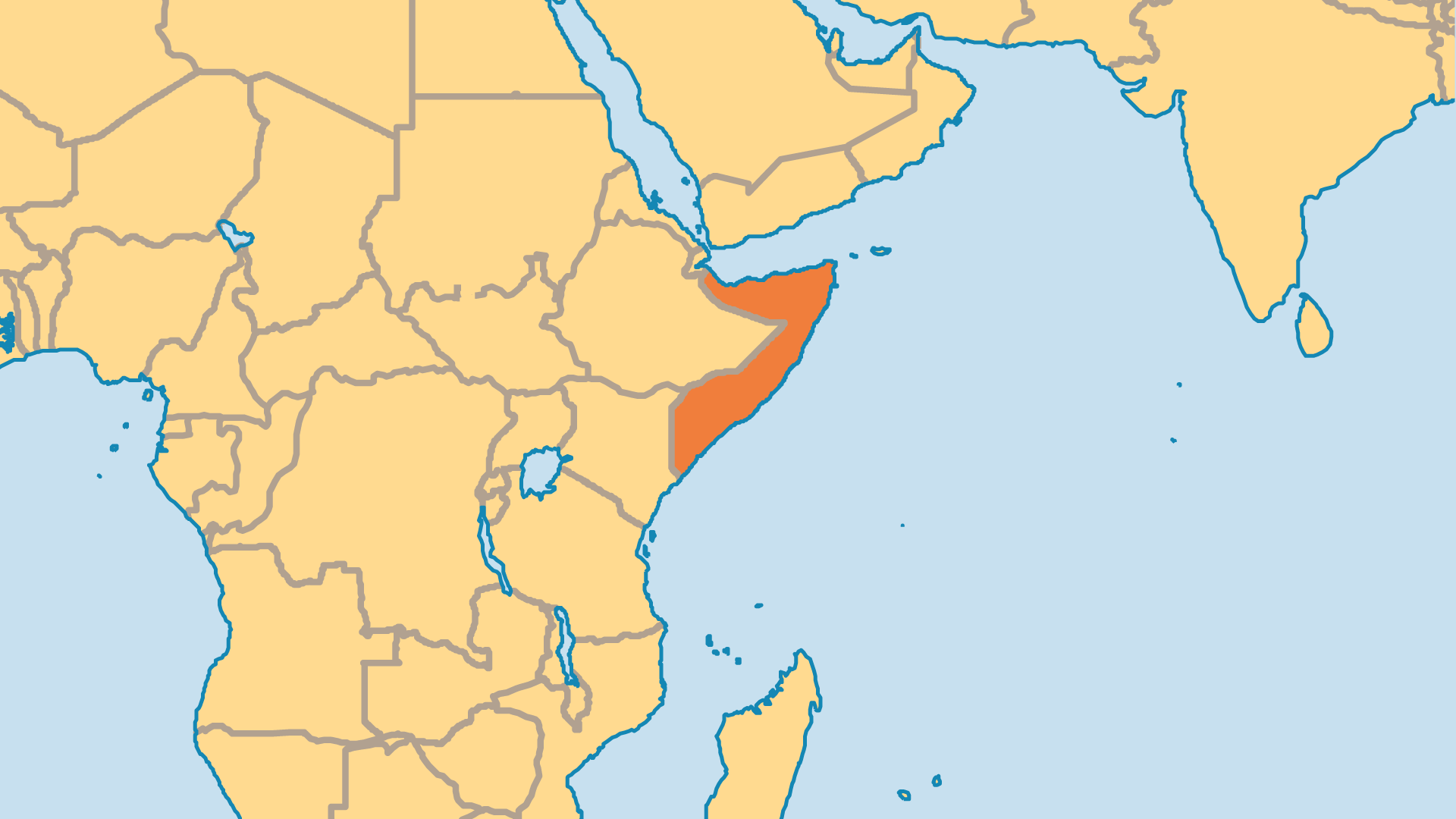
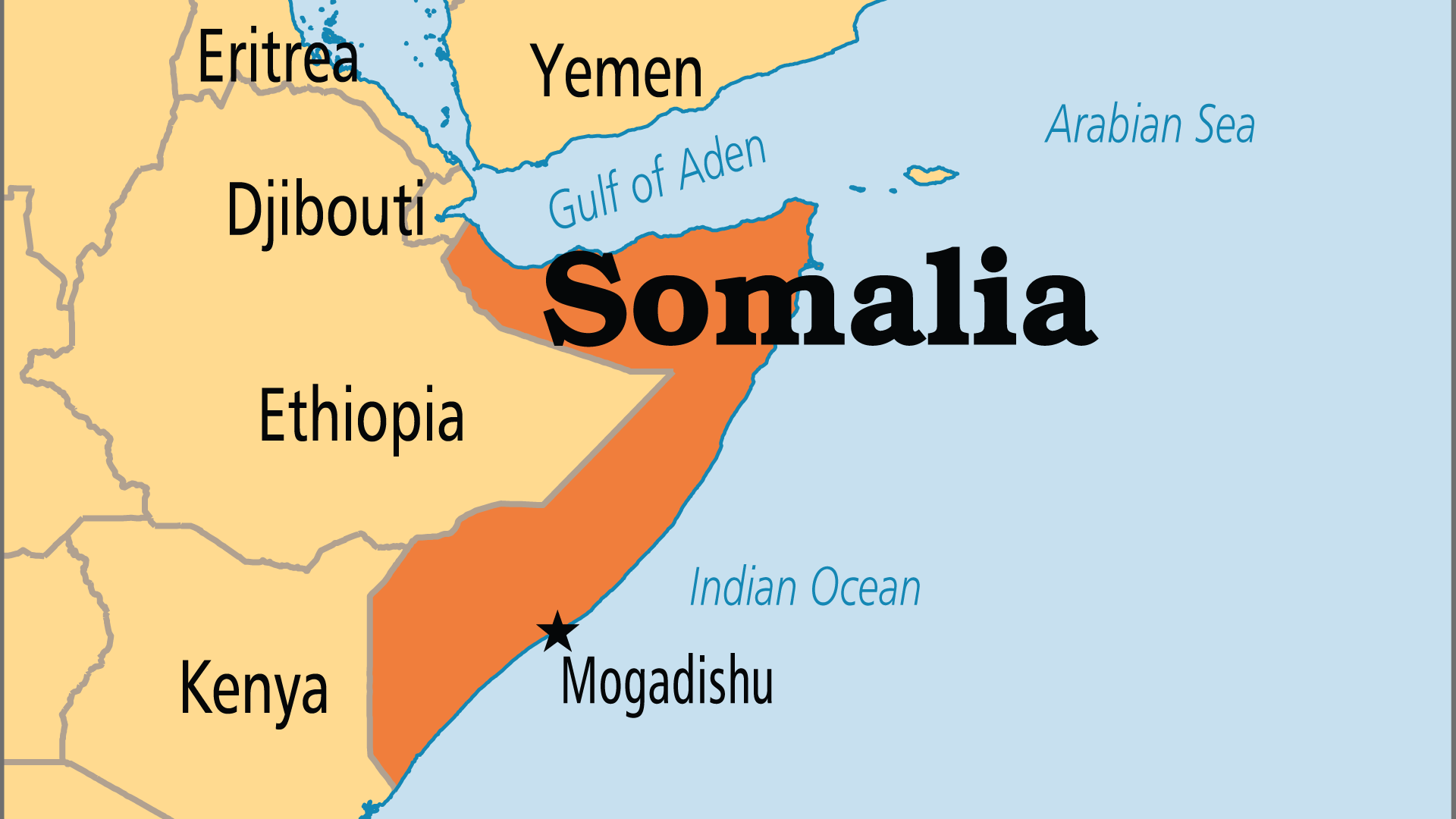
Area 637,000 sq.km. The arid Horn of Africa east of Ethiopia and Kenya.

Population Ann.Gr. Density
2000 10,097,177 +4.25% 16 per sq. km.
2010 14,130,792 +3.17% 22 per sq. km.
2025 21,211,280 +2.51% 33 per sq. km.

These population figures are broad estimates and likely to be too high. A further one million are refugees in Africa, Yemen, Europe and North America.

Capital Mogadishu 900,000; Somaliland: Hargeisa 350,000; Puntland: Garoowe. Urbanites 37%.

PEOPLES

Somali 97.4%. Complex hierarchy of clans based on paternal descent.

Northern Somali 77%. Four major clan families: Dir, Daarood, Hawiye, Isxaaq. Numerous clans and sub-clans; largely semi-nomadic.

Southern Somali 20.4%. More despised; some mixed with Bantu ex-slaves, largely agricultural. Main clan families: Digil, Rahanwiin (Maay-speaking) 650,000; Garre 50,000; Jiddu 44,000; Tunni 43,000; Dabarre 38,000 – all related to Somali.

Bantu 1.6%. Wagosha-Mushungulu 85,000; Benadiri-Bajuni Swahili 40,000.

Other 1%. Oromo 50,000; Arab 30,000; Eyle Khoisan (Bushmen).

Literacy 24%, but in decline. Official languages Somali, Arabic (few speak it). All languages 14. Languages with Scriptures 6Bi.

ECONOMY

Subsistence pastoral economy – largely camel or cattle herding; some agriculture in south and north-west. Economy in ruins in Somalia, and controlled by warlords trading in narcotics, arms and food aid. Majority of population totally dependent on food aid and remittances from relatives abroad. No formal economy exists. Some recovery and reconstruction in Somaliland.

POLITICS

United as a single country in 1960 soon after the British (in north) and Italians (in south) granted independence to their respective fiefs. Cold war rivalries provided Somalia with ample weapons – first from the USSR, then from the USA – for disastrous wars against Ethiopia and clan fighting. These brought the country to destitution. The corrupt and repressive dictatorship of Siyaad Barre ended in a bloody civil war in 1991 but with no viable alternative government emerging. The country slid into clan warfare with warlords vying for power. Most of the fighting has been in Mogadishu and the agricultural lands in the south, which induced terrible famine. UN intervention in 1992 was a disaster and resulted in humiliating withdrawal in 1995. Anarchy has reigned since then with no national government. In late 2000 a transitional national government was formed in Mogadishu. Somaliland in the north-west declared its independence from Somalia in 1991 but remains unrecognized internationally. Puntland in the northeast has set up its own autonomous government.

RELIGION

Islam is the official religion. Islamists gained influence in both the south and Somaliland and seek to enforce shari'a law. There were many Ethiopian Orthodox refugees in Somalia during the 1970s and '80s. Persecution index 25th in the world.

Religions Population % Adherents Ann.Gr.
Muslim 99.95 10,092,128 +4.2%
Christian 0.05 5,049 +4.2%

Christians Denom. Affil.% ,000 Ann.Gr.
Protestant 1 0.00 0 n.a.
Independent 1 0.00 0 n.a.
Anglican 1 0.00 0 n.a.
Catholic 1 0.00 0 n.a.
Orthodox 1 0.03 4 -2.6%
Unaffiliated   0.01 1 n.a.

Churches MegaBloc Cong. Members Affiliates
Ethiopian Orthodox O   1,400 3,500
Catholic C   116 200
Other denoms [3]   0 79 165
Total Christians [5]   0 1,595 3,865

Challenges for Prayer

1 Somalia is the most lawless country in the world. In contrast, the unrecognized Somaliland has a good measure of stability and peace. After 10 years of violence and anarchy, Somalis are desperate for peace and restoration of civil order. Tentative efforts to form a government are ignored or derided by some of the warlords. Pray that all factions may agree on the formation of a national government and that future rulers might learn from the past, govern the nation for the good of its people, respect human rights and also grant true religious freedom.

2 Islam has failed the people. Two powerful competing Sufi brotherhoods have contributed to present troubles. The evident greed, intolerance and lack of love have discredited Islam. Some are seeking solutions in radical Islam. Many Islamist teachers have flooded into Somaliland and Puntland where there is more stability. Pray that Islamist plans may be thwarted and a new religious tyranny prevented.

3 National recovery is the need, but the population is traumatized by suffering, death, famine and the savagery of the fighting. Over 300,000 have died. Over 25% of all children under five perished. Pray for:

a) Wise administration of aid. The UN and the many NGOs involved in the 1990s unwittingly became the suppliers and sustainers of the war – the militias helped themselves to weapons, supplies and equipment. Pray for protection and effective ministry for aid workers – many of whom are Christians.

b) Refugees and ministry to them in Kenya (500,000). There is need for ministry to the refugees in Ethiopia (200,000), Yemen (60,000), the Gulf and the West also.

4 The work of missions has been limited, dangerous and hedged with restrictions, and in 1974 was forced to cease. Swedish Lutherans won a few hundred to Christ in the south between 1898 and 1935. Mennonites and SIM (1953-74) also saw a few hundred turn to the Lord. Pray for workers for the Somali to be called, prepared and ready for the opening of these defiantly closed doors.

5 The Somali Church has been driven underground. A number of believers have been martyred, others have been publicly named as targets for execution. In 1991 there were about 500 Somali Catholics and several hundred Evangelicals – most being secret believers and nearly all in the south; with few in Somaliland. Some have since fled the anarchy, taking refuge in Kenya, Ethiopia, Yemen and elsewhere. Globally there may now be 2,000 Somali Christians. Pray for their protection, growth in the faith and boldness to witness when opportunities arise. Pray also for Somali Christian families to be raised up – the great majority of Christians are men.

6 Strong prejudices against Christianity need to be broken down. These are:

a) Muslim association of Christianity with oppression – may refugees and recipients of help from Christians be touched and respond.

b) Perceived incompatibility of Christianity with nomadism – 60% of Somalis are semi-nomadic.

7 About 3.5 million Somalis live in surrounding lands. Ethiopia (approx. 2.8m); Kenya (511,000); Djibouti (192,000). SIM, SBC, Life Ministries, CBIM and others have a ministry to Somalis in Kenya, and RSTI in Djibouti. Pray for Christian aid workers and their tactful witness. Pray that all these ministries may have an impact on Somalia itself and that viable Somali churches may be planted.

8 Christian specialist ministries:

a) The Somali Bible was published in 1977. Distribution is only possible in refugee camps and among Somalis outside Somalia. Pray for the wide dissemination of the Scriptures.

b) Bible translation is definitely needed for the Maay Somali, whose language is somewhat divergent.

c) Christian radio has been a major means of lessening anti-gospel prejudice and aiding the conversion of Somalis. Pray for the work of Somali Voice of New Life (CNC-SIM) based in Nairobi and broadcasts of FEBA (30 min/day) and TWR (15 min/day). It is a constant struggle to maintain, and a challenge to expand, this service.

d) Follow-up Bible correspondence courses are run by CNC – with a thousand or more active students in 13 countries. The collapse of postal services in Somalia has hindered any meaningful follow-up ministry.

Internet Links

| Top | Home | Pray Today | Prayer Resources | Updates | OW Team | Contact Us | Policy | Tech Support |
.